Artificial Intelligence (AI) is changing the way people live, work, and use technology. From voice assistants and chatbots to smart recommendations and self-driving systems, AI is becoming part of everyday life.
But what exactly is artificial intelligence, and how does it work?
In this beginner-friendly guide, we will explain what AI is, how it works, its different types, real-world applications, benefits, and limitations.
What Is Artificial Intelligence?
Artificial Intelligence is a branch of computer science that focuses on creating machines and software capable of performing tasks that usually require human intelligence. These tasks include understanding language, recognizing images, solving problems, learning from information, and making predictions.
AI systems use data, algorithms, and computing power to identify patterns and produce results. Some AI tools can answer questions, generate text and images, translate languages, and help people complete everyday tasks.
AI does not think or understand the world exactly like a human. Its abilities depend on how it is designed, trained, and used.
How Does Artificial Intelligence Work?
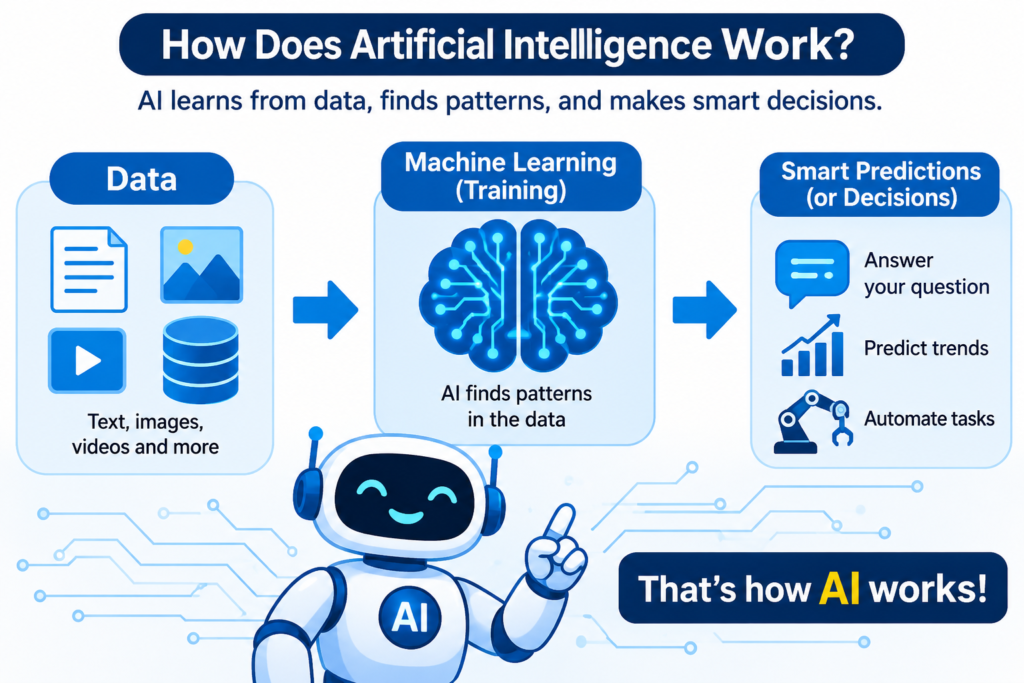
Artificial Intelligence works by processing data and using algorithms to identify patterns, make decisions, or generate results. The exact process depends on the type of AI system.
Most modern AI systems follow a few basic steps:
- Data collection: The system receives information such as text, images, audio, or numbers.
- Training: A machine learning model learns patterns from examples in the data.
- Processing: The trained model analyzes new information and uses what it has learned.
- Output: The system produces a result, such as an answer, prediction, recommendation, or generated image.
AI systems can improve through training and evaluation, but their results are not always correct. Human review is important, especially when decisions have serious consequences.
Types of Artificial Intelligence
Artificial Intelligence can be classified in different ways based on its capabilities. Two common categories are:
1. Narrow AI (Weak AI)
Narrow AI is designed to perform specific tasks. Examples include voice assistants, recommendation systems, spam filters, and facial recognition software. Most AI tools used today belong to this category.
2. General AI (AGI)
Artificial General Intelligence refers to a theoretical form of AI that could perform a wide range of intellectual tasks at a human-like level. It has not yet been achieved.
Understanding these categories helps explain the difference between today’s practical AI tools and the more advanced AI systems researchers hope to develop.
Common Applications of Artificial Intelligence

Artificial Intelligence is used in many industries and everyday activities. Some common applications include:
1. Healthcare: AI helps analyze medical images, organize patient information, and support medical research.
2. Education: AI-powered tools help students learn, practice new skills, and find explanations for difficult topics.
3. Banking and Finance: AI helps detect unusual transactions, identify potential fraud, and support customer service.
4. Transportation: AI supports traffic management, navigation, and the development of autonomous vehicles.
5. Business: Companies use AI for customer support, data analysis, automation, and improving productivity.
6. Entertainment: Streaming platforms use recommendation systems to suggest movies, music, and other content based on user interests.
Benefits of Artificial Intelligence
Artificial Intelligence offers several benefits when used responsibly:
- Automation: AI can handle repetitive tasks and save time.
- Efficiency: It can process large amounts of information quickly.
- Accuracy: AI can help identify patterns and reduce certain types of human error.
- Availability: Some AI-powered services can provide assistance around the clock.
- Better decision support: AI can help people analyze information and make more informed decisions.
However, AI results should always be checked because systems can make mistakes or produce misleading information.
Limitations and Challenges of Artificial Intelligence
Although AI offers many benefits, it also has limitations and challenges:
- Data privacy: AI systems may process personal or sensitive information, so data protection is important.
- Bias: AI can produce unfair results if its training data contains bias.
- Incorrect information: AI tools can sometimes generate inaccurate or misleading answers.
- Job changes: Automation may change the skills required for certain jobs.
- Security risks: AI can be misused to create scams, fake content, and other harmful activities.
- Human oversight: Important decisions should not rely entirely on AI without proper human review.
Responsible development, careful use, and suitable safeguards are essential for reducing these risks.
The Future of Artificial Intelligence
Artificial Intelligence is expected to play an increasingly important role in the future. Researchers and companies are working to develop more capable AI systems for healthcare, education, science, business, and everyday life.
Future developments may bring better automation, more personalized digital services, improved research tools, and new ways for people to work with technology.
At the same time, privacy, security, fairness, transparency, and responsible use will remain important. The future of AI will depend not only on technological progress but also on how people and organizations choose to use it.
Conclusion
Artificial Intelligence is an important technology that is changing many parts of modern life. It helps people automate tasks, analyze information, solve problems, and discover new possibilities.
For beginners, understanding how AI works, where it is used, and what its limitations are is a useful first step toward using this technology responsibly.
At Techsnopy, we aim to make AI and technology easier to understand through practical guides, useful information, and beginner-friendly explanations.